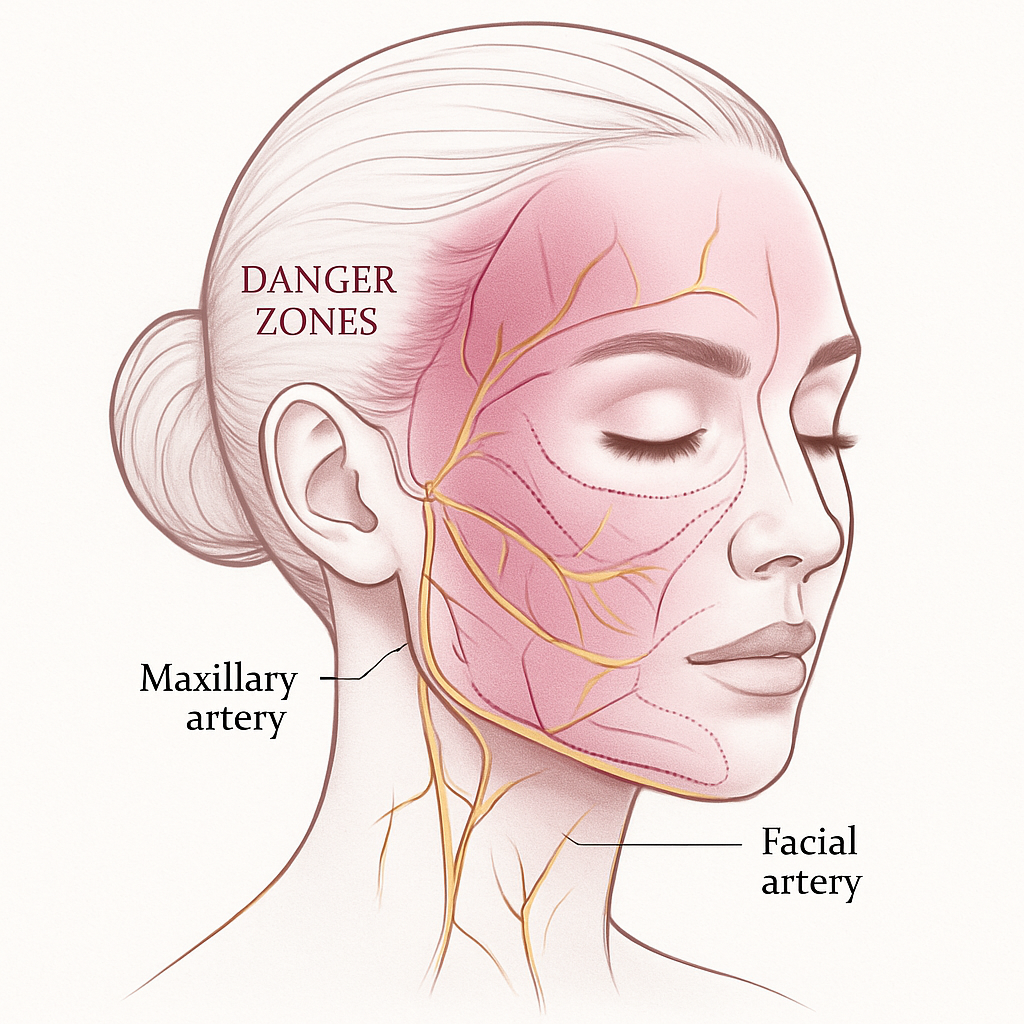
Dermal filler injections have become one of the most popular cosmetic procedures worldwide. However, not all injectors have the same level of anatomical knowledge a factor that directly impacts both results and safety. Advanced anatomical mapping is the foundation of safe, effective filler treatment at Magenta Clinique.
Understanding facial anatomy is not just about knowing where to inject its about knowing where NOT to inject. The face contains complex networks of blood vessels, some with direct connections to the eyes and brain. This comprehensive guide explains how anatomical expertise protects you and ensures beautiful, natural results.
What is Anatomical Mapping for Filler Injection?
The Mental Map of Facial Structures
Anatomical mapping involves creating a detailed mental and sometimes physical map of key facial structures before injection. This includes the location of arteries, veins, nerves, muscles, and fat compartments. Expert injectors understand how these structures vary between individuals and how to navigate them safely.
The Journal of Cosmetic Dermatology emphasizes that thorough anatomical knowledge is the most important factor in preventing serious filler complications. Injectors must understand the three-dimensional relationships between facial structures at every depth and location.
50+
Facial muscles mapped
20+
Critical blood vessels
6
Major danger zones
Understanding Facial Danger Zones
Certain areas of the face carry higher risk due to their blood supply. These danger zones contain vessels that connect to the ophthalmic artery, which supplies the eye and can communicate with brain circulation. Here are the key areas every patient should know about:
Glabella (Between Eyebrows)
High RiskContains supratrochlear and supraorbital vessels connected to ophthalmic artery
Safety precautions: Small volumes, superficial placement, aspiration, consider avoiding in inexperienced hands
Temples
High RiskSuperficial temporal artery and deep temporal vessels with intracranial connections
Safety precautions: Cannula preferred, subcutaneous plane, small boluses, aspiration essential
Nose (Non-Surgical Rhinoplasty)
High RiskDorsal nasal artery with anastomoses to ophthalmic circulation
Safety precautions: Very conservative volumes, superficial placement, experienced injectors only
Tear Troughs
Moderate-High RiskAngular artery and proximity to orbital structures
Safety precautions: Deep plane injection, cannula strongly recommended, limited volumes
Why This Matters
Vascular occlusion when filler blocks a blood vessel can lead to tissue death (necrosis) or, in severe cases affecting the ophthalmic artery, vision impairment or blindness. While these complications are rare, they are preventable with proper anatomical knowledge and technique. This is why choosing an experienced, trained injector is crucial.
Safe Injection Techniques Based on Anatomy
Aspiration Before Injection
Pulling back on the syringe before injecting to check for blood vessel entry
Appropriate Depth Selection
Choosing the correct tissue plane based on the area and desired outcome
Cannula When Indicated
Using blunt-tip cannulas in high-risk areas to reduce vessel penetration risk
Small Bolus Technique
Injecting small amounts at a time rather than large deposits
Needle vs. Cannula Selection
The choice between sharp needle and blunt-tip cannula is based on anatomical considerations:
Sharp Needles
- • Precise, superficial injections
- • Areas with minimal vessel risk
- • Lip border definition
- • Small volume touch-ups
Blunt Cannulas
- • High-risk vascular areas
- • Tear troughs and temples
- • Larger volume treatments
- • Reduced bruising potential
Area-by-Area Anatomical Considerations
Cheeks & Midface
The midface contains the facial artery, infraorbital artery, and angular artery. Safe injection requires understanding the different fat compartments (malar, submalar, deep medial cheek) and placing filler at appropriate depths.
Dr. Fawzi approach: Deep plane injection with aspiration, small boluses, and massage to distribute product evenly.
Lips
The labial arteries run along the lip borders. While generally safer than other areas, improper technique can still cause vascular events or achieve unnatural results.
Dr. Fawzi approach: Precise border definition with sharp needle, body filling with serial puncture or linear threading, always respecting natural anatomy.
Jawline & Chin
The marginal mandibular nerve runs along the jawline and can be affected by improper technique. The mental artery exits at the chin and must be avoided.
Dr. Fawzi approach: Supraperiosteal injection for structural support, careful palpation to identify mental foramen, respecting nerve trajectory.
Forehead & Temples
The temporal fossa contains the superficial temporal artery with intracranial connections. The forehead has supraorbital and supratrochlear vessels.
Dr. Fawzi approach: Cannula preferred for temples, superficial subcutaneous plane, ultrasound guidance for complex cases.
Our Safety Approach at Magenta Clinique
Multi-Layered Safety Protocol
Pre-Treatment Assessment
Detailed facial analysis, medical history review, identification of individual anatomical variations
Anatomical Mapping
Mental mapping of danger zones, palpation of arterial pulses, marking key landmarks when needed
Appropriate Technique Selection
Choosing needle vs. cannula, depth, and injection method based on specific area anatomy
Advanced Safety Tools
Ultrasound Doppler guidance for high-risk areas, hyaluronidase on hand for emergency reversal
Continuous Monitoring
Watching for signs of vascular compromise during injection, immediate response protocols if needed
Questions to Ask When Choosing an Injector
Your safety depends on your injector knowledge and experience. Here are important questions to ask during consultation:
- What is your training in facial anatomy?
- How do you identify and avoid danger zones?
- Do you use cannulas? When and why?
- What safety protocols do you follow?
- Do you have hyaluronidase available for emergencies?
- How would you handle a vascular complication?
A qualified injector should be comfortable discussing these topics in detail. If your potential injector cannot clearly explain their safety approach, consider that a red flag.
Frequently Asked Questions
How common are serious filler complications?
Serious vascular complications are rare (estimated at less than 0.001%) when performed by experienced injectors with proper technique. However, the consequences can be severe, which is why prevention through anatomical knowledge is essential.
Can anatomical variations make some people higher risk?
Yes, there is individual variation in blood vessel pathways. This is one reason why thorough assessment and conservative technique are important for everyone. Some patients may have vessels in slightly atypical locations.
Is anatomical mapping performed at every treatment?
Yes. Even for returning patients, we reassess facial anatomy at each visit. Anatomy does not change, but our injection plan may vary based on treatment goals, and we maintain our safety protocols consistently.
Experience Safe, Expert Filler Treatment
Book a consultation with Dr. Maggie Fawzi at Magenta Clinique. Your safety is our priority with every injection we perform.
Magenta Clinique, Maadi, Cairo